

Pre-Build Activities
Welcome to the visual journey of my Cobra kit car build!
This page is dedicated to how it all started, and the challenges, and the triumphs that got me to the starting line
Garage
Now that I've committed myself, it's all hands on deck (that'll be me) to get the garage ship-shape. And to that end, the garage was like Steptoe's junkyard. It needed sorting. I've been promising myself (and the wife) to do it for years, but somehow I never got around to it. I've tinkered, shifted, re-shifted, stacked, re-stacked, tidied and re-tidied but never really spent much time beyond the event horizon, that being the boundary which is just inside the door. Over the years, all the "stuff" just became more compacted and older.
So I Present To You My Single Garage..... or as I call it, the "TARDIS"
Time Accumulated Repository of Decaying and Incidental Stuff
As you can see, my garage is somewhere to horde junk, bits of wood and half-empty tins of paint on the off chance I might need to repair or touch up something in twenty years' time. Moreover, whilst sorting and sifting through the accumulation, moving ever so slowly past the event horizon towards the back of the garage, I discovered some spare parts for a vacuum cleaner I ditched ten years ago..... WTF!
A major challenge for me was to work out how to contain the equivalent of two cars within a single garage. Specifically, to be able to store the non-joined-up body and chassis in the same space at the same time. This is where a real TARDIS would be very useful. But as most of us know, the TARDIS doesn't exist, and I, not being a Time Lord, had to come up with a solution that conforms to my garage dimensions. So I made a body trolley to make it easier to work on the shell and to move it around without having to resort to steroids, protein drinks or going to the gym to do pointless gravity-defying feats with lumps of metal.

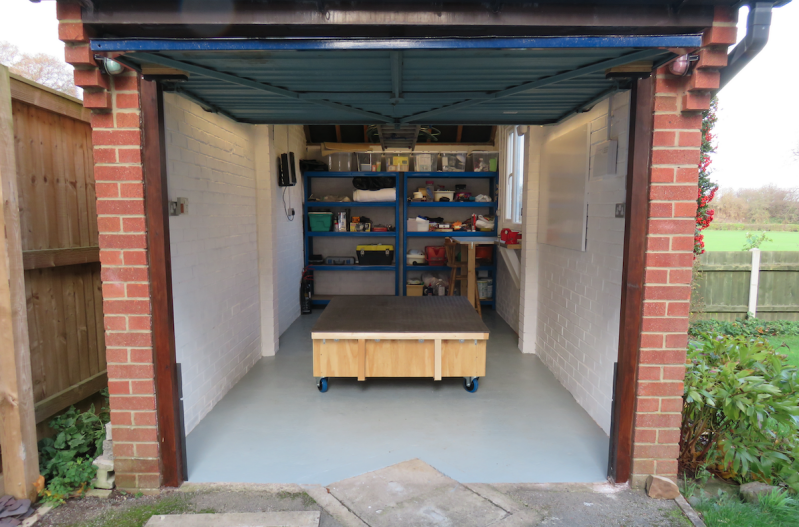
Door:
- Replaced the frame (The Garage Door Team) - Harrogate branch
- New paint job
- Added a couple of strong deadbolt locks
- Fitted a weather seal along the bottom of the door to stop leaves and dirt from being blown in -and to keep the garden frogs out
- Sealed along the top of the door with stripes, the leftover rubber matting from the trolley. This is to reduce drafts and to keep the heat in during winter

Equipment & Tools: Initially, I put together an enthusiastic and comprehensive list of what I perceived as essential equipment, i.e. axle stands, an engine hoist, shiny metric and AF spanners, an air compressor with associated noisy man-cave attachments, a hand and bench grinder, and last but not least, a pillar drill. But in reality, because I'm going the GDEuro route, initially, the only thing I will need to get is a Dremel with some attachments, a vice, a combination rivet/rivnut/Jacknut gun and a drill stand for my drill.
Things I will need to get when I get the chassis and engine are: a torque wrench, axle stands and a trolley jack. So..... equipment-wise, it seems what I've accumulated over the years, i.e. a well-used socket set and the usual stuff that anyone who tinkers with the non-complicated bits of a car, will suffice.
Review of Garage Improvements
Infrastructure:
- Installed an alarm system (This being a "proper" alarm with a couple of PIRs & an integrated fire sensor)
- Made a wall-mounted, fold-down workbench
- Made a smaller fixed workbench for the vice and drill stand
- Painted the floor battleship grey
- Painted the walls white
- Replaced the window (Niddal Windows)
- Put up a black curtain to stop prying eyes from looking in when I'm not around
- Made a wall-mounted tool board where all my tools will neatly reside after every build session [go figure]
- Bought new shelving (BIG DUG)
- Improved the lighting by using high-frequency strip lights
- Put in more electrical sockets
- Installed a wall-mounted heater
- Installed an external light-sensitive PIR and a couple of bulkhead lights (These were used as an additional security deterrent and to illuminate the driveway and door area when approaching or leaving)
- Had an electrician install a new RCD consumer unit and connect everything up
- Evicted the spiders
So now that I'm organised,
I can crack on..! 🤩

Delivery
Oh Yes!!!
Hired a van to collect my car from GD. However, this seemingly simple activity nearly turned into a nightmare scenario. The GDEuro MkIV body is 391 cm (length) x 180 cm (width). Luton vans vary in size from 317-420 cm (length) x 202 cm (width). Conversely, a long wheel-base van, i.e. not a Luton, has intruding wheel arches so one of those was out of the question. Luckily, I had the company check the dimensions of the van I was going to get; it could have been an expensive trip to bring back a van full of Long Bennington fresh air, a windscreen, and a couple of cardboard boxes of car bits.
Pre-Pickup Checklist:
- Checklist
- Invoice
- Mobile phone
- Satnav
- Address of the factory in Satnav
- Today is the right day
- Check to make sure the insurance for the kit starts today
I arrived at GD bang-on the pre-arranged time; driving down the hill, and just before I turned into GD I spotted my car sitting outside... Inert and radiant under the grey skies of Roseland Business Park. And after a surreal "that-must-be-mine" moment, I parked the van and walked sedately to the office, feeling very apprehensive.
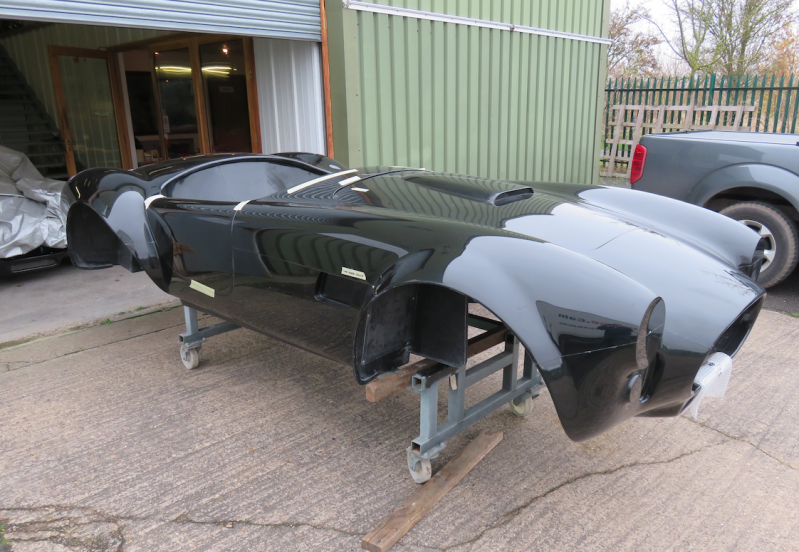

A very quick couple of hours later, all items were secured in the van, and I was ready to be on my way..... And travelling back home, I began to understand how Charles Lindbergh felt when he took delivery of his plane, 'The Spirit of St. Louise.'
Extract from the book "FLIGHT" by Robert Burleigh
"Flight, Loneliness, Fear, Danger.
The courage to dream."
Charles Lindbergh didn't know he would never see Paris when he left Long Island early that morning in May 1927. But he did know that he had to try. He had a dream, and he knew he had to make it real. He was just twenty-five years old.
Many thought he was foolish, too young to know better. No one before had ever flown across the Atlantic alone without a stop. Why did this Lindbergh think he could? With no radio or parachute, and only two compasses and the stars to guide him. Lindberg set off on his journey. The rest is history.
In Robert Burleigh's vivid, intimate telling, experience Charles Lindbergh's thirty-three and a half hours across the Atlantic as if you were there. Coupled with Mike Wimmer's bold, dramatic painting, Flight is an extraordinary story of courage and endurance that will inspire anyone who has ever followed a dream."