

How Hot Is Hot?
How many times have you been asked: “I see you have the same engine as me! How hot does yours run?”
A good question, as it’s a great conversation topic and ice-breaker, and a question that could cause the need for loads of beer and a takeaway (delivered, obviously).
But how ‘hot’ is hot?
I’ll ramble on for a while and return to the answer at the end of this article…
Background: Apart from being in a maternity delivery ward having my knuckles crushed with increasing frequency, waiting for the cooling fan to kick in when running my new engine for the first time was [so it seemed] equally traumatic - but so much less painful.
But now, after many runs out and lots of observing and learning as to what’s going on with my setup, the trauma has died down somewhat. And in reality, how ‘hot’ is hot is dependent on several factors… Not least the ‘where’ and the ‘when’ you take the readings, and what your mental threshold is with respect to chickening out and switching off, because you have no clue as to what’s really going on inside the waterways, but it seemed like the right thing to do at the time - just in case.
And in the grand scheme of things, the major variable is where you put the sensors. Yes, the usual places are one on the rad’ side and one on the engine side; but on the radiator side there are many places to insert a prob or place an inline sensor, and usually this is the one that feeds the dashboard gauge.
And having seemingly been pressurised to agree by all-and-sundry, who have endured and [arguably] survived the traumatic experience of waiting for the fan to kick in and cool things down a tad, it’s quite obvious they have their own expectation of the value already. So the question is kinda moot.
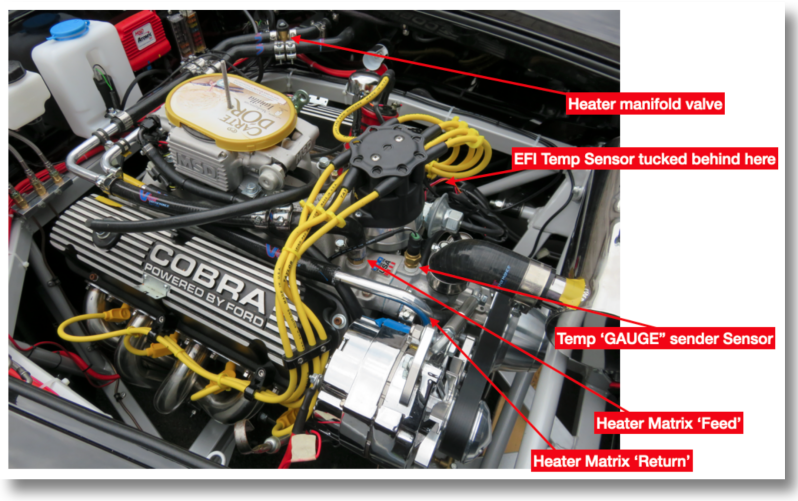
On my Edelbrock intake manifold, the engine temperature sensor, which feeds real-time telemetry to the ECU, is tucked away neatly on top, and my gauge sensor [rad’ side] is not too far away on top of the thermostat housing; but I’ve seen sensor probes on the top and bottom radiator connection hoses and all points in between on the same type of engine.
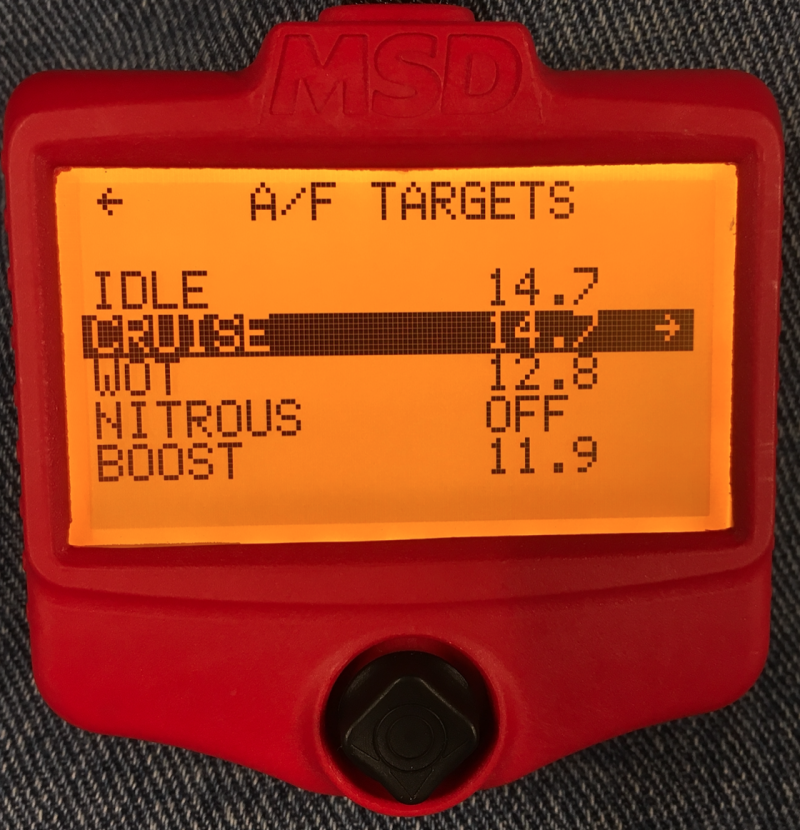
And what about the engine variables that can cause all sorts of self-induced trauma..! A selection being: A loose drive belt; a badly set up carb; a manky fuel filter; dirty jets; auto choke, manual choke; the lambda plug or an exhaust leak letting air in upstream, or a seemingly innocuous leaky vacuum line; the Idle Air Control (IAC) baseline grub screw setting, non-optimal stoichiometric air-fuel ratio settings, or other ECU settings that are best left alone and we shouldn’t have fiddled with because we know best…
And how many times have we come across someone who has removed the thermostat altogether because their engine was running hot!
Moreover, many a time I’ve seen a sturdy owner weep - not at the cost of petrol or at the sight of distant, really dark grey clouds heading their way and they’ve realised their soft-top is 100 miles away in the garage; but because something is not right ‘up-front’. The hotter-than-normal engine and the smell of petrol are the source of multiple irritations and a potential personal meltdown - and not least the irritation of knowing that the vapour is permeating into their cherished Irwin jacket.
> And how big a fan do you have or need?
> Is it sucking or blowing?
> Is the induction motor polarity correct, and is the leading edge of the blades cutting into the airstream?
And what temperature is all this ‘stuff’ set to kick in and switch off?

And let's not forget about the radiator cap!
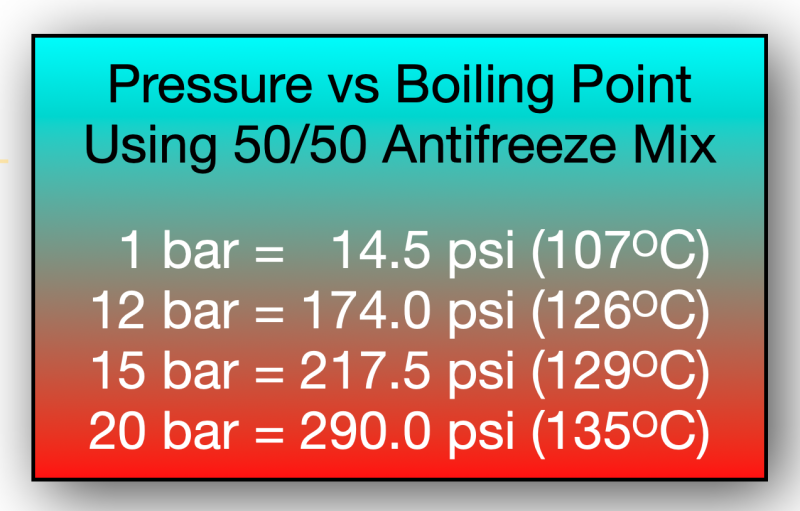
This is probably the most important item in your system. My engine is fitted with a 15 lb psi cap as per my engine documentation; Pressure vs Boiling Point, and using 50/50 Antifreeze Mix
* 1 bar = 14.5 psi (107 degrees C)
* 12 bar = 174.0 psi (126 degrees C)
Instructions: Although a higher psi cap is good for preventing overheating, a lower pressure cap is good for not blowing pipes off.
Moreover, a faulty cap can cause the pressure not to normalise in the system when the engine cools down, therefore causing hoses to collapse; or if the radiator cap gets stuck, the pressure will build inside the radiator and potentially cause a leak or a burst of a cooling system component… Seriously not good!
My whopping 16-inch fan very efficiently takes care of the ‘hot’ side of the temperature stability equation, and the 15 lb psi cap is matched to my Ford 302 needs; however, it seems a 20 lb cap is common on higher-performance engines to keep the temperature down - by keeping the pressure up.
Note: I’m not going to talk about waterless coolant because that is a whole new world of brain-strain and graphs. However, I really do see the attraction of a pressureless cooling system; but [apparently] waterless is a bit more gloopy than the glycol-based products… So, as gloopier means thicker, potentially, waterless could retain heat more
I’m also not going to talk about hose clamps; although this would be the point to do so… Worm Drive, T-Bolt, Spring Clamp, V-Band, Ear Clamp and Constant Tension Worm Gear clamps, to name the usual suspects
And last but not least [for this bit], is there a heater matrix in the waterworks, and are the pipes on the right way round?
Yes, it does make a significant difference if they are not!
Why? I hear you ask… Well, the reason for this is that the water pump [in my case], has a return inlet port that is ‘suction', so when the water pump is rotating, water flows out of the top outlet of the intake manifold and feeds the lower inlet pipe on the heat exchanger; then, the water flows up through the exchanger and out of the top outlet pipe and back to the lower water pump inlet port.
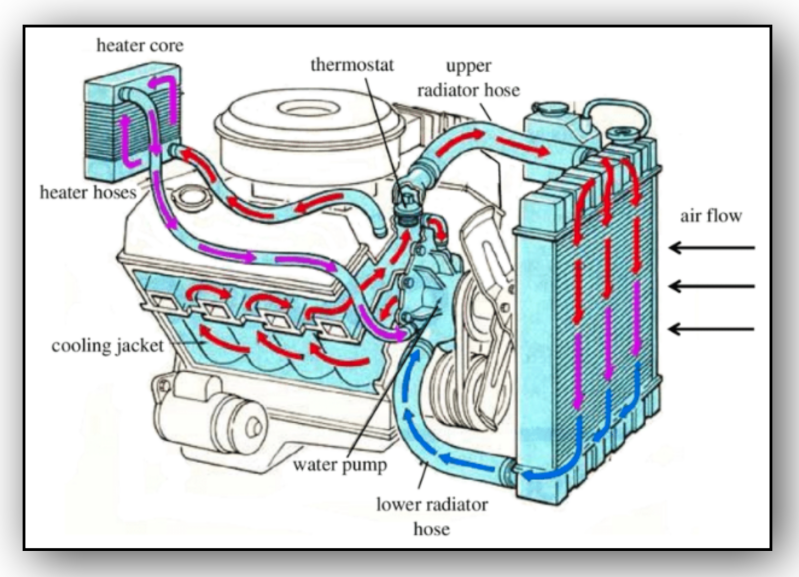
This configuration is necessary because, as bubbles and heat rise, any air in the system will percolate upwards with the natural flow of the water feed and will be flushed out of the system. Connect things up the other way, and any air has to be forced down through the heat exchanger by the flow of the water... i.e. against gravity... Not good.
And what about the ’when’? In traffic! In winter! At altitude! On the driveway! Or after a major voluntary twitch of your right foot on a quiet and secluded straight road where the last thing on your mind is the state-of-play of a small gauge which isn’t in your line-of-sight!
And what about the who? The who being the who, who nonchalantly moseyed up to you and asked the question after slowly and discreetly circling your creation a couple of times like a vulture circling before quickly swooping to feast on some lifeless carrion.
Or the who, who can’t [metaphorically speaking] work in new money… I’m taking nomenclature here… We in the UK speak in OC, but our American cousins O degree F, unless, of course, he/she is on the James Webb Space Telescope (JWST) team, where they work in O degree K (Kelvin)
So, in theory, the “how-hot-is-hot” conditions need to be fully defined before we respond; so I suppose the correct answer to the question is…
“Fill in this questionnaire, and I’ll get back to you in a week or so”
And for completeness of illustration, here is a graph of my engine temp sensor values. Data was obtained very unscientifically, i.e. in the garage when I got thinking about the time I was asked the simple but niggly question at Stoneleigh.
Notice the ~5 OC difference between the engine and radiator side… Am I worried about this? Nope… this makes sense! So as long as the fan kicks in at 83’ish as per the factory spec and my gauge reading, I’m good...
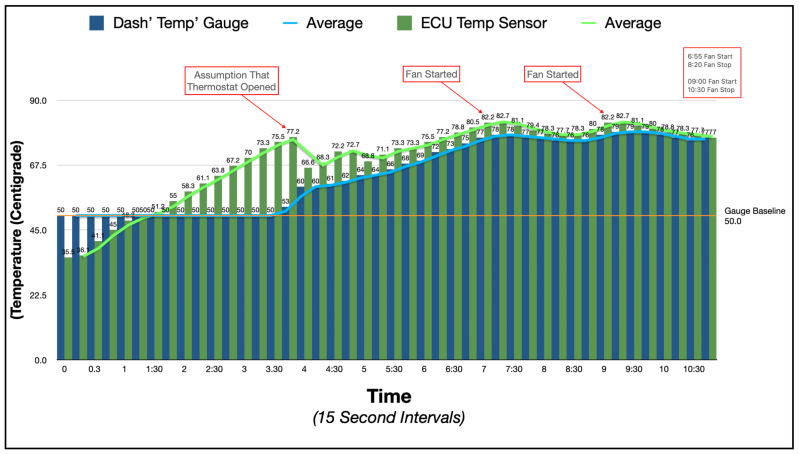
...By the way! My MSD EFI/ECU controlled Ford 302 with its 16-inch [suction] fan is set to kick in at 82 degrees C and to switch off at 77 degrees C. And when pootling around with a smile on my face, the running temperature is ~65 degrees C (that’s ~338 degrees K if you are part of the JWST team).